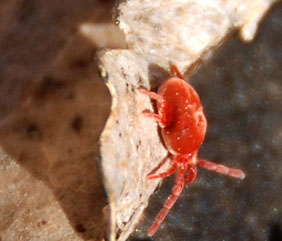
 When we took a picture of this little critter - one of the first ‘bugs’ we’ve seen this spring - we realized that we didn’t know what it was. We had both seen them all our lives - like little balls of velvet with legs, we had often found them crawling about in the deep woods - impossible bright dots on brown leaves or bark. Thinking that they were mites of some kind, we typed ‘spider mite’ into google and were dismayed to find nothing except for a lot of references to the extermination of everything ‘mite-ish’. It took a lot of digging to discover that our observation of the creature’s velvety appearance held the key to its name - we had taken a photo of a red velvet mite.
Hailing from the family Trombidiidae, there is actually very little known about these creatures - Liam Heneghan, an ecosystem ecologist from DePaul University who was interviewed in this article for Chicago Wilderness Magazine, called them an ‘under-researched enigma’. He did explain that they are chelicerates, making them closely related to spiders and scorpions, and told of their fascinating mating ‘dance’, where the male lays down sperm along a branch and then crafts a silken trail to entice females to come and sit down on his sperm. He also hinted that their bright red color is a warning that the mites have a terrible taste - he said that he’s placed them on anthills and observed no ants moving in for what would seem like an easy meal.
It’s known that the red velvet mites play a vital role in the decomposition process. But the details of that role are still missing.
We’re going to pay more attention this summer when we see one of these little mites. They can be fast, and in the varied terrain of leaf-litter they’re not always easy to follow, but we’re excited to see if we can get a glimpse into their lives. If anyone else knows any interesting facts or has had their own experiences with the red velvet mite, we’d love to hear your observations in the comments!
Here is another picture sent in by a reader:

Posted on April 6th, 2009 by Kenton and Rebecca
Filed under: Bugs and Crawlies!




Wonderful! I first encountered these creatures as a grad student in Arizona- one of many startling invertebrates I learned about that first year in the desert. Had no idea they were in your bailiwick, but… nice of you to share them with all of us.
Oh, and as I recall, they came out only briefly, a few days perhaps, after rain…
Hello Sally — We think there are uncounted species of these critters that must range over diverse habitats — we thought they were only dwelling in constantly moist areas like the deep forest, but you’ve described finding them in the desert. Fascinating! They certainly are mysterious little creatures, and so unexpected when you see one.
Thanks for your comment!
Amazing little thing!
Hello mon@rch -
Isn’t it? We just saw another one the other day while digging for our garden. Such curious little creatures . . .
Seen these gentle creatures at the start of every monsoon in south punjab(Bathinda) as a kid, about 25-30 years back. Only they were larger, from about 3mm - about 8mm across at the trunk. i’m wondering why none of the web literature mentions this size. my mum told me they are called ‘Velvet Boochies’ and i would keep them in a jam bottle, assuming it would eat the grass kept along with it. none of them ever survived overnight.
Greetings Deepak,
What a great name for them — Velvet Boochies =) It’s quite interesting that none survived the night. There are so many species of these mites — we saw a large one the other day, but it was no more than 4mm. 8mm would be a true giant, but it sounds as if mites of this size were common for you to find? It’s not a well-known family, so perhaps you were seeing a species that hasn’t yet been described in scientific literature.
We have these little bright mites in the country here in West Texas, Big Spring to be exact. I just moved out here and never noticed them in town but they are everywhere you look out here after a rain. In fact a friend calls them rain bugs. I have to watch where I am walking to keep from stepping on them. They range in size from about 2mm to about 8mm. I was out taking pics yesterday. Nice to know a little more about them.
Hello Julie,
These are apparently all over the world, and have a propensity to become more active after rain. They sure are amazing little buggers, aren’t they?
Hi Kenton, Rebecca,
In India, they’re commonly referred to as ‘Bir Bohotti’ or ‘Birbaboti’. They’re very popular with kids in India who collect them in match boxes. Unfortunately, as Deepak said, the misconception is that they eat grass or even red soil so they don’t survive long in captivity. I’ve seen these grow up to 1 cm. From what I could gather on the internet, they eat larva and eggs of other insects, and can live up to 18 months. I live in Houston and I would really like to get my hands on a few so I can learn how to successfully keep them alive in captivity. Any suggestions on how I can find them?
Raza
Houston, TX
Hello Raza,
Thanks for the great info! We loved hearing that kids collected them — but it would be nice to be able to help people understand what they need to survive in captivity. We’re excited for your experiment! Please let us know if you are successful.
The climate is much different in Houston, of course, but it seems that a lot of people report finding them after a rain. We mounted two small expeditions in the last two days so that we’d be able to answer your question, but curiously we didn’t find any! Usually, they seem almost ubiquitous in the environment, but perhaps the weather lately (rain, heat, high humidity) is keeping them in their little homes. Usually, we find them on dead logs, and often on bare soil — but our guess is that it’s simply that we’re seeing them because they’re on a surface which makes them more visible. If we ever figure out more about their habits of appearance, we’ll post it here =)
Hi Kenton, Rebecca,
Thanks for your efforts. It would be great to finally figure out what these little ones eat and how to keep them alive and share that info back home. Part of this effort is driven by my guilt as a kid for mistreating so many albeit with the best of intentions. India has one of the most amazing varieties of wild life but unfortunately the concept of animal rights is almost non-existent there. In my home town, Hyderabad, we have a fairly large zoo (380 acres) but since it’s govt run, the condition of the place is below par. I went ahead and put up a site for them. http://www.hyderabadzoo.in …an improvement over what they had before http://www.hyderabadzoo.org. Thanks to cable tv, people are getting more informed tho.
Raza
Hi everyone,
I returned from Rajasthan yesterday, and to my surprise I saw two of these red little velvet like bugs. I picked them up and played with them, they were sooooooo cute. I never saw anything like them.
Its amazing what nature brings to us, if we look. They were soft like jelly, and didn’t bite. They were in the middle of the parking lot of a hotel I stayed at. I was there two days and only found two bugs. I moved them to the side of the driveway so they didn’t get run over. I couldn’t believe how bright red they were. I wanted to take them home but I knew that they won’t survive if I did. So I left them where I found them. Wow.
Leena
Hello Leena Desai!
Thanks for saving those two. We saw on the other day on our deck — all we could do is stare! They are truly beautiful, and so mysterious! What are they up to? Thanks for the fun comment!
I was hiking today in southern AZ east of Tucson and we encountered about a dozen of these creatures. We had never seen them before. It was on a trail in the low desert on the side of a canyon. It rained the night before and reading about them, this is probably what brought them out.
Hello Mike — Another rain connection! They’re getting more difficult to spot here in Wisconsin, since the undergrowth has pretty much turned things into a jungle.
Seeing them for the first time must be really amazing. Their vivid color always startles us!
I grew up in Nagpur, India, and I have seen them off and on in grassy fields following the monsoon rains. I was often tempted to bring one home but never did as I always thought they will miss their family and friends. Now I have 2 children and often tell them stories from my childhood, I hope I can show them the mysterious Velvet boochies someday. Interestingly enough, there are juicy red small velvety berries that grow in hotter places in India, the phalsa berries, which are extremely delicious, I searched on the net and found that they are called Juniper berries globally. The velvet touch being the common amongst the two, the boochies and the phalse go hand in hand in my memories of outdoor escapades as a kid.
Hello Sonali, Redmond!
What a wonderful thing to hear! It’s amazing how memories from our childhoods can become blended into such magical tales. We hope that your children enjoy the stories that you share! We’ll have to see if we can learn more about the phalsa berries from the internet or the library =)
I was delighted to spot the red mite (Birbaboti as referred to by Hyderabadis) crawling across the walkway inside the KBR national park early in the morning today. The park,some 400 acres of natural brush located smack in the middle of the bustling city of Hyderabad attracts hundreds of nature lovers for brisk walks.
These cudly mites crawl out of the ground after a day of showers. Like the rest of India, Hyderabad too has been concerned at the paucity of rainfall this year. Witnessing this Birbaboti which we used to play with as children, reassures me that the monsoon will be adequate after all
Dear Syed Ali Ishrati,
I am so happy to hear that the Birababoti has served as a harbinger of rains to come! What wondrous little creatures they are! Thanks for taking the time to share this wonderful story =)
Hi Ali Ishrati,
Glad to see a fellow Hyderabadi run into birbabotis at KBR. I’ve never been to that park. I’ll check it out on my next trip to Hyderabad.
P.S. Do you know Samad Ishrati from Chicago?
Hi! Just one last thing, are you Christians? If not then what are you?
I am writing a science paper on the velvet mite and I can only use one source on the computer. I have decided to use yours! I am in 7th grade and I am home schooled. Homeschooling is so much fun! Right now I am learning to draw the world. We started with South America, we had two weeks to learn all the countries, capitals, some boies of water, a few other features such as the Galapagos Isles and Teara del Fuego and to learn to draw it. Than we did Canada, we also had two weeks to learn the provinces and capitals plus many bodies of water and rivers also a few other features. Then we did Meso Amercia, we had two weeks again andwe had to mark ALL of the lesser Antilies (sp?) Now we are doing the USA, we have three weeks but there are 40 rivers, 16 other water features and 50 states (as I’m sure you know). I am on my 2nd week and I still haven’t finished looking up all the rivers in my atlas. I have made 100′s on all my tests so far! My plan is to try really hard and make A’s on all my geo tests all year. At the end of the year we draw the WHOLE WORL all at once, marking all the countries, provinces and capitals. I love home schooling! I am 12 yrs old, my birthday is Dec 23rd, I was doing Algebra 1 but I wasn’t really getting it so I took a step back to Algebra 1/2. I really like math, I just don’t like doing the lessons in my book. I hope I’m not wasting your time telling you about my school work
please reply very soon,
Sara
Sorry for all the mess-ups I clicked summit before rereading it. Oops!
Sara
oops again, *submit
Hi Sara!
Please accept our apologies for the late reply — we are in a film right now, and don’t get to check our email or blog very often.
Thanks so much for using us as your ‘Red Velvet Mite’ source! With all the great comments people have left, we’ve learned a lot about these little creatures!
It sounds like you’re doing awesome in school! We have a lot of friends who are homeschooled or who homeschool their children, and we love to do our snake presentations for homeschoolers, as they’re among the brightest audiences we’ve encountered. Keep up the awesome work — it’s great to hear that you have so much excitement about what you’re learning. Those who carry that excitement for their whole lives are the ones who really seem to enjoy life the most.
No, we’re not necessarily Christians. Closer to Zen or Taoism, but it might be closest to say that we’re just part of nature.
Thanks so much for writing!
Sweetwater,
Kenton and Rebecca
waaaw, I’m from the United Arab emirates and this is a blast from the past the last time I’ve been in India was 18 years ago in Hyderabad and yes i’ve encountered these creatures many times during the monsoon .. and if i remember correctly they grow even larger than 1.5CM and I’m sure Raza remembers the song the kids sing for these creature ” Birbaboti kol ja” which means “Birbaboti open up ” because they curl up when you hold them and I think they react to the sound and then they start opening up.
Fascinating! It would be wonderful to hear the song. We’ve appreciated so much how so many people have contributed their thoughts, remembrances, and knowledge about these creatures. Thanks for adding yours!
i stumbled upon your site by chance and it really made me nostalgic and brought back fond memories of my childhood. i too, like a couple of your respondents, hail from the south indian city of Hyderabad, although i’ve been living in Jiddah, Saudi Arabia for the past 34 years. my (maternal) grandparents had a big house (2500 sq.yds) in what was then the outskirts of the city, with a huge garden. i remember after the first rains of the monsoon we used to get up early and run to the lawn to see if the velvet bugs had emerged and we were rarely disappointed. after spending almost the entire year underground these critters emerged briefly after the first rains of the monsoon and then disappeared again when the rains got heavier. the lawn used to be literally carpeted with these beautiful soft to the touch bugs. this is perpahs the only bug people wudn’t mind crawling all over them. the minute they were touched they would roll into a tight ball and it wud be a while before they became active again. i have often wondered how deep into the earth they burrow and live for nearly 11 months of the year. hope someone will delve deeper into this and unravel the mystery.
kind rgds/tyyeb
fascinating reading about a bug i hv always loved!
Hello tyyeb!
We can hardly imagine so many of them! They must have been so beautiful, emerging in such great numbers. We want to go to India just to see them =)
This has been a remarkable post, in that the comments tell so much more than we ever could have written. Thank you for adding your voice and helping to bring back memories for those people who have experienced these wondrous creatures emerging after the first monsoon rains.
I grew up in South Texas. I remeber these insects growing up and was absolutely fascinated by them. I loved to search for them after the rains; however, I recall many more when I was younger (about 15 yrs ago) than what I see now. My mother told me they were ‘angels’ when I inqired as to what they were.
Hi Debra!
Angels! Another new name for them! We’ve been watching the first ones emerge this spring, and sitting mystified as we watch them wander about in their mysterious errands. Every year we are re-amazed at the impossible red color, the soft and furry velvet. If we were more their size, they seem like they’d be great for cuddling!
hey guys im in 3rd grade and i was useing this info for my assignment THEY ARE SO INTERESTING if these critters are white my brother is useing like perying mantis to kill them from eating our roses THIs info is so helpful i hope i get a A+ in 3rd grade form with this stuff !!!!!!!!!!!!!!!!!!!!!!!!!
Hi Shane!
We hope you get an A+ too! Good luck! =)
Like all of you here, I belong to Hyderabad in my childhood I use to catch those little Velvet creature called “BirBaBooti” I use to keep in my Aluminum school box , yes they die in a day or two and yes we thought they eat grass but i don’t think so thats how they die (starving death), I think they lay eggs but don’t remember now, dam!! after 40yrs of age we tend to forget childhood. I still dream about them (catching and keeping them in that box) by the way after that short while of emerging “BirBaBootis” I could not find them again even I dig for atleast a meter deep I don’t know how come they disappear so quickly.
Now I am in US since 9yrs and roam around so many states but never found a single “BirBaBooti” .
Here is a request if anyone of you got a pic of BirBaBooti please post it here. I love them all my life.
Also there is a flying bug called “Bhanvara” it has green shiny solid hard wings (like metallic paint) it is usually found in the begining of mansoon and usually on a Berry tree (bare ka jhad), the food for this flying creature is leaves of Berry tree, it looks like firefly but much larger size maybe two to three inches, It has a unique quality it can pinch your finger in its neck (between head and body) I got pinched many times, definately I remember I lay eggs (different colors, green, red, pink) the egg size is equal to poppy seed.
Hello Zaheer,
What beautiful memories! Thank you for sharing. These little creatures left quite an impression on so many people. If you remember anything else about them, please share, as they are quite mysterious.
Thanks as well for telling us about Bhanvara. If anyone knows what this might be, do let us know.
hello,hey i have them now at home.last week had gone to our farm house n we collected nearly 40 of them ,right from a tiny one to a big one.am going to leave them in the garden as i dont know if they will survive in captivity and also what do they eat?
Hi mmk,
That’s a lot of them! As for what they eat, it’s a fun experiment to watch them and see if you can see them eat anything. We’ve watched and watched, but it’s very difficult to tell if they’re eating anything. Apparently, they’re actually hunting, eating very tiny critters.
hello kenton and rebecca,
I left them in the garden yesterday coz they were not looking too good and i feared they might die,but took a couple of pictures of them though.wonder if i can post them on ur site???
Hi mmk —
Some people have asked for more pictures to be posted — please send them to us at the following address: spiderslippers (at) yahoo (dot) com, and we’ll post them above. We’re excited to see them! =)
hello kenton and rebecca,
have sent a few pictures of birbaboti’s ,hope you will like them.
have a nice day.
my husband and i live in a rural area in south eastern new mexico. on our land we found red velvet mites, have you ever heard of them in new mexico? also do you know how to get rid of them because we don’t want to spread?
Thank God there are other people who have had these as pets! I was just googlin when I found this blog and being an Indian myself, this brought back fond memories I miss those bugs a lot!!! They were the cutest ever! I used to keep them with me in a liddle homemade garden and they each had name!! Omg they were the cutest ever!! Now I live on a mountain and a year ago I saw a baby velvet mite, I was so happy, but while I was walking it flew out of my hand
  Haven’t seen one ever since. Really wish I could! Thanks so much for bringin back some nice memories guys!
Hi D’aun,
We have heard of them in New Mexico. As far as getting rid of them, they are apparently 100% harmless, and are actually very important in the soil for helping things grow. So if you have any plants you like in your yard, those mites are helping them stay as green as possible. They spend most of their time hidden, so you probably will only see them at certain times.
Hello Susie!
Glad we could help! =) We sure love those little critters. How wonderful that you named them all! And that must have been so sad to meet one and then lose it — we’re not sure where you’re writing from, but if you check carefully in the leaf litter and on some old logs, perhaps you’ll find one again. We wish you the best of luck Susie!
When I was growing up in Hyderabad in the 40s, each year monsoon winds started to blow over the city from the west in the second half of May, and the rains arrived promptly between the 5th and the 10th of June. As if by some magic, these beautiful little velvety blood-red creatures, could be seen the next morning crawling, peacefully and noiselessly, on the damp brown earth.
The show, sadly, lasted no more than a week.
Beautiful, Safdar!
What lovely memories these tiny insects have given so many people!
they are so interresting animal
: )
We also find then in the arid Northern Cape province of South Africa, but they only appear for a day or two after it rains, which is once or twice a year. The farmers in the area simply call them “rain bugs” because they appear after rain.
Hi Rene!
Rain bugs! We haven’t heard that name yet. They sure are popular little creatures . . . =)
I am getting some Red Velvets. I’m guessing that they could eat smaller size Roaches. I read somwhere (can’t locate it now) that they will eat fish food!
I have read that they will eat fish food!
We call Birbaboti in Hyderabad Deccan and it close its legs when bothered or touch there stomach. It normally found in grassy area with black mud in a normal rainy season. We use to keep them in small aquarium with mud and fresh grass and they live for few weeks as far as I remember back in late 70′s.
I live in Canada and I have them in my garden. I noticed then only a couple of weeks ago. I also read that the adult male will host on animals and sometimes humans…. Children are playing with these!!!!!
i first saw these little bugs lke 15 years ago in west texas after a soft rain shower. there was so many of them crawling all over the ground. i thought they were soo beautiful! i havent seen them ever since that day and i still sometimes walk around after a rain shower hoping to see one.
I’ve more than six red velvet mites & i’ve kept them in flower pots. they seem to like their new home. they all went inside the soil at night. they are still in good shape. i want to keep them the same way. can anyone suggest what should i feed them or what would be appropriate food for them. i love them. reply soon…!
Hey everybody. Just got back from my daily hike up in the hills. I live in New Mexico, not Mexico, has nothing to do with Mexico. We are in our monsoon season here and it is slightly wet. I see the red velvet mite every year at this time up in the rocky hills. They are very interesting creatures. When I first saw them I thought they were ticks. I looked them up in the computer and found out that they are mites and related to the spider family. I don’t know what they eat, but I’m assuming they are scavengers. Enjoy them while they are out. They will soon go back into hiding till next years monsoons. Robert
Hi Robert!
These things are all over the place! What remarkable creatures =)
Hi Sumit,
We’re just not sure what to feed them. We imagine that if you took the soil/sticks/leaves/etc. from where you found them, they should be able to obtain food from their imported environment =)
Hi Sandra,
Funny how they stick in one’s memory, isn’t it? They’re so remarkable . . .
Hi Lisa!
In Canada too! We haven’t heard of them hosting on animals or humans — could it be possible you’re referring to another animal, perhaps a tick? These are very soft-bodied and delicate, and we’ve handled them many times without them ever biting or doing anything harmful. If they attached on to someone, they’d be squished by the barest bump. These creatures are truly harmless and beautiful.
These bugs are also in South Texas. My grandpa told me they were called angel bugs because they always came after the rain which is much needed in our area. It’s nice to know their “real names”.
Hi Lizette!
They’re EVERYWHERE it seems =) They sure are beautiful and intriguing, aren’t they?
This little creature reminds my schooldays, we used collect them in matchbox for fun. We call them ‘arudra purugu’ in our regional language ‘Telugu’. Some people also call them as ‘birba boti’. There was a funny proverb on them “Birba Boti Naan ki Roti Tere bache rorein darwaaaza khol “. I think they eat grass and soft soil. Generally they came after the rain.
Hello manoj!
We haven’t heard that name! Would you translate the proverb for us?
I can’t believe these amazing creatures, so tiny and cute. I found one in my grandma’s back woodsy area under a dandelion plant in Pennsylvania. I put it in a jar and want to keep it but I don’t know what to feed it either. I put some soil and leaves from the area where I got him. My grandma wants me to let it go. What do you think?
I am from Hyderabad, but was raised 140 km from Hyderabad I am reading all the comments from other users and I could recall my childhood memories I love nature, I spent all my childhood in Nature Lap, we had lot of trees and birds nest, watching birds , their nests and eggs, different kinds of dragon files , all the stages of butterfly from larvae stage to becoming a butterfly ,playing in small ponds and lakes and one of them is Velvet Mites.
Me and my brother used to collect then in match boxes and used to play with these little velvet mites with our neighbors. we had huge open grass lands , we could see them in first season of Rain. They would be crawling through the grass. it was very picturesque to watch them like red dots on Green carpet. they live in lots of these mites were killed by walker,cycles as they crawl on roads
My mother never allowed us to catch them , since they are very sensitive will easily killed . she used to say it is sin to catch them .so we stopped catching thim , but actually she meant not to hurt them
Zaheer.. was mentioning about Bhanvara, it is Black Bumble Bee
and
Manoj’s Proverb or funny song ..! Birba Boti Naan ki Roti Tere bache rorein darwaaaza khol “
means ..
Birba Boti ( Velvet Mite) .. Naan Ki Roti ( Indian Bread ) a Rhythmic word ….
Tere Bache Rorein — your childrend are crying..
Darwaazaa Khol - Open The Door
Hope you liked it …
Found one on a tree in the yard. Took video with my phone.
http://www.youtube.com/watch?v=Kxs8KIgPTTk
Hi Chuck,
That’s a great video, especially from your phone! Aren’t they beautiful little creatures?
Hello Pranav,
Thank you so much for translating that song, and for writing of all your memories. We had no idea when we wrote about these creatures that it would become a gathering for people who share so many memories of them in their childhoods! =)
Hi Cara,
Aren’t they great? Letting it go would of course be nice for the mite, but if you’re interested in learning more about it, you could read through the comments and see if anyone has any ideas of what to feed it. If you brought in soil, leaves, and sticks from where it was found, it will probably find all the food it needs there. Many people have said that they’re quite delicate. It would be interesting to hear what you decide =)
I am a teacher in Austin,Texas. During our 1st Grade team meeting this afternoon the subject of these little red bugs came up. A few of the city dwellers had never seen them, but I grew up in South Texas in a very small town and we used to see them after rain storms in the summer. My mom always referred to them as “anjelitos” but we never knew their real names. I stumbled into your site and was very pleased to finally know what they are. Haven’t seen them since childhood and probably never will again.
We came across one of these mites in our garden yesterday and got some pictures and recorded it climbing on a tree. Fascinating things. Very pretty but sparse info on web. We can send the film but we’re not sure how.
We live in the very dry West Texas town of Midland, We had a 2″ rain and two
days later i went to the shooting range and there were hundreds of these
little critters. very velvet and bright red.
I have recently found one of these little creatures floating in my pond…I found it twice ,so obviously it can cope with water.I had never seen one before…so have used the internet…and this site.
The most interesting fact is that I live in Scotland…in South Lanarkshire.I was wondering if it is native here ,or if I had introduced it.
Looking back at the other comments..maybe it was after the fish food!
Hello Marta!
Anjelitos! We hadn’t heard of that name yet! This post is becoming a compendium of velvet mite knowledge =) Some folks from Texas have told us they find them after a rain, down among the leaves and sticks.
Hi Deborah and Max,
Aren’t they great? And yes, difficult to find info on them. This is becoming sort of a mini-encyclopedia of velvet mite knowledge right here! If you upload to YouTube we can post a link in your comment. =)
Hi Bill! Hundreds! That must have been amazing to see! They’re getting abundant in our Wisconsin woods right now — we tend to have them all the time, probably because it’s usually moist ground.
Hi Alison!
Scotland — this is the first we’ve heard of them in that part of the globe. We’re not sure if they are native or not. Perhaps over time we’ll here more about the Scottish mites! Sounds like they can swim just fine . . . =)
Found some near Mulshi, Pune - after reading the comments, i feel they are every where
Hi Mohsin,
Everywhere indeed! We’re wondering about Australia, which often has its own select fauna. Anyone ever seen them Down Under?
Hi! Kenston and Rebecca this site may proves helpful to the lovers of little red bugs as i am one of them. They are known as “RANI KEEDA” in urdu language which means queen of insects.I strongly belive that this insects carry cure to some diseases and found that oil from this insects are helpful for paralysis and are used in medicines for maleria. They are also known as Indian Viagra as are used to cure sexual problems.
saw these insects in june . they appear every year in this month only after the first showers .i also tried to keep them in a glass jar half filled with the clay taken from the area in which they were found ,,, but they did not survive ,,.they vanish as fast as they appear ,,.we could not figure out from where they came from or to where they went away after a week of appearance on the land ,,…..
Today 7-1-12 it was da first time I had ever seen them in my life.. I live in south texas border w mexico so they are not only in deep forests.. n yes it did rain yesterday n came out today.. my dad calls them “angelitos” spanish for little angels.. n he said da last time he saw one it was more dan 45 yrs ago.. him n his frndz would play n collect them too… its interesting to know where they are b4 da rain n how do they appear?? I tool pics w my phone n did zoom n got awesome pics
It rained yesterday July 1st, and this morning I was pulling weeds from the garden and my girls spotted hundreds of these red velvety bugs, they collected some in a butterfly container that has a magnifying glass on one side, they filled it half way with dirt and all the mites are digging and making burrows and then they just stay still. They dig with they’re four small legs on the front and push down with their hind legs. They are not good climbers though. Wish we could know more about them. Oh, and we are from South Texas and there is a lot where I live.
Today is day 2 and the red velvet mites are still alive in the butterfly observation box, my daughter put some fish flakes in there but can’t tell if they’ve eaten any.
Hi Lim!
Wow! That sounds like a HUGE bunch of them! Neat that you brought some in for observation. We’ve heard rumors about them eating the fish food, so it would be interesting to hear if you observe any of them munching it.
Hi! It sounds like there has been a ‘hatching’ or something in southern Texas! We like this new name for them — “angelitos”. They sure have a lot of nicknames!
Hello Juweria!
Fascinating! We hadn’t heard of any medicinal uses for them. And a new name — Rani Keeda! Thanks for sharing =)
Hello Shoukatullah Hussaini,
It is indeed a mystery — where do they come from, and where do they go? Are they new ones hatching, or are they just hiding somewhere . . .?
I’m in Tucson, AZ. We had a pretty strong monsoon yesterday and I found 3 of these little guys in my pool.
Interesting that they come out during the monsoon in India. That is when I have seen them in Arizona. I photographed several on South Mountain in Phoenix July 4th 2012. They were huge! At least 1- 1.5 cm long. I would send in some pics, but I can’t attach any to this.
Wow I love these little guys…I lived in India first 8 yrs of my life and I remember a bunch of us little kids gathering a hunting party after a rainy day and finding these mites and playing with them…they don’t bite or anything and they are found under dirt n around places they can easily hide…so u have to look hard (tats the fun of it) I love their color n velvety coat
I live in southern AZ at about 5000′ near a drainage from the Huachuca Mountains. I noticed these little cuties about 5 years ago, but only during the monsoon season. They are abundant right after a rain, then decrease in numbers until the next rain. The ONE in the picture on my Monsoon Walk posting today was the only one we found while walking two days after a rain. They were EVERYWHERE the day before. It was also smaller than the average we saw right after the rains — about half the size. I’ve not seen one larger a smidge over 1 cm in length and this one was about half that size.
Thanks for this site. I’ve been wondering what they were for some time and finally found an answer!
I live in West Texas and we just got much needed rain as we are suffering a sever drought in our area. I was taking the trash out when a bright red dot caught my eye in the driveway. I have lived in West Texas for 29 years and have never seen this creature before. I would assume they are not native to our area given that we don’t have wooded areas. But I will be more aware now and see if I spot anymore of these little guys!!
These creatures are so cute and fluffy. I took one and put it in my yard and it’s never to be found again. I did some research and found they feed on other smaller insects who eat fungi, and they also eat insect and human skin flakes. It is perhaps impossible to pet them. But you can drop them in your lawn and find them in monsoon next year.
Regards,
Rayan
Mumbai, India
Greetings Rayan!
Wow! They eat other smaller insects and flakes of dead skin? Cool! Do you know the name or type of smaller insect? It would be really fun to learn more about these amazing creatures, but it sometimes seems that information is limited . . . Thanks for sharing what you know!
Hello Kara!
Hmmm, perhaps these cute little creatures are trying to spread happiness by taking over the world . . . Strange that you’ve never seen one before this. You’ll have to take stock and let us know in a year or two if you start seeing more and more of them. Enjoy!
Hi! So interesting that these critters follow the monsoon. Makes us wonder exactly what part water plays in their life cycle . . . Do you have a link to some of the pictures you took? Do you think the ones you saw were babies? You’ll have to see if you notice the area population increasing in size over time. Thanks for sharing!
Hi Gloriya!
What a wonderful and fun image of a hunting party of kids, all out after the rains looking for living red jewels . . . How lucky we are that we get to see these little guys on a regular basis where we live! Perhaps they live everywhere, but are just really small in some parts of the world . . .
Hello Jasun!
Do you have a link to any of the pictures you took? They are certainly pretty enough to warrant multiple pictures and it would be amazing to see examples of some of the bigger ones that are living here in the United States!
Greetings Sheree!
Sounds like there are an abundance of these beauties out in AZ! Were the ones in your pool still alive and well? Wonder what they were doing there . . . Enjoying the afternoon, poolside?
Midland Texas: I used to see these alot as a child growing up in West Texas. Saw them today, on the edge of town in a residential neighborhood. There was a taranchula trying to get in the house after a rain 2 days ago. Now these beautiful red velvet bugs are out! I was told they are ticks, so I was researching and found your website. I really didn’t believe it and glad you have this info available.
Thanks
Hiked this morning in South Mountain Park here in Phoenix (AZ). Yesterday it rained, so the ground was pretty moist. Not only were the Desert Millipedes out in force, but I saw 24 of these Red Velvet Mites widely distributed over a less-traveled section of the trail, up on a ridge. Never seen them before even though I have hiked this trail probably 20 times. Clearly, the rain drew them out. They were all about 1/4″ to 3/8″ long.
This is the most information I’ve found on these colorful arachnids! Have seen about 24 in a quarter mile of cracked rural road in central Arizona after the monsoon rains, ranging greatly in size. The largest two I saw had about 4 white spots lower on their backs. Thanks for the interest and info!
We live in West Texas, recently moved to the outskirts of town and we get tons of them after it rains! I wonder if it’s safe for my children to play outside around them?
I am staying at the KOA campgrounds between Carlsbad & Artesia in New Mexico and I did notice after the rains they were everywhere on the back road of the park. It’s a rocky area with short weeds n grass. No one in the park could tell me what they were. They are very tiny….I haven ‘t seen a big one yet. I walk my dog often and they were only out in the mornings. They are very interesting …. So happy to have found your Blog.
Hi
I was so very surprised to find this blog. I grew up in Ranchi in the state of Jharkhand in Northern India. Every monsoon these beautiful things would appear on the lawns in front of the house we lived in. We called them “Gho Gho Rani”. Me and my mum would pick them up to feel their velvety texture. They are a part of my happiest memories I collected them in matchboxes too with grass because that is what I thought they ate. Thankfully I let them go after a couple of hours or as I know now, I would have killed them.
They stopped appearing in our compound around the years (2002-2003). I just don’t know why and I really missed them. I thought I would never see them again. But what I have read has given me hope.
Thank you so much for starting this
Regards
Divya
OMG! what a wealth of information about these lettle Beerbottis, in my memories of childhood in Jalandahr in the Northern Punjab, India. I always speak about them to my kids and grandkids and tell them how fortunate I am having witnessed these beautiful creatures, which I had never seen after we left that area and I was under the impression these are already extinct by now! OR these might be native of Jallandhar only and always wished to visit there one day in the monsoon season just for another glimpse.
I am so overjoyed to stumble upon your site that has such a wealth of information and am so happy to know they are also found in the USA as well - closest to me is Tuscon Arizona (I live in Southern Nevada) - which I can easily visit and won’t have to go all the way to India!
Thank you so much, Kenton and Rebecca, for your postings on line and thanks to all the others who have shared their stories and experiences and videos for the lovers of these little velvet creatures.
If only I could know when they appear in Tuscon…!!!
We live in sub-saharan Niger, and we see hundreds of red velvet mites after each significant rain during the wet season which is from end June to end-August. Ours range from tiny to quite large, about a centimeter. Our perception is that they come up above ground because the earth is so saturated with rain water. We rarely see them during the rest of the year, unless we are digging in the garden and stumble onto one in which case they seem to be quite inactive and possibly dormant.
Hi Rachel!
Aren’t they beautiful? They’re perfectly safe and harmless, and have featured in the happy childhood memories of many of the people who have commented here. We hope your children have fun exploring the world of these tiny creatures!
hi,everyone!
I found this red velvet mite 5 days ago and i put it in a polythene bag and i forgot it, after 4 days when i see it not moving and i thought it is dead but i did an experiment i put it in rainy water on my hand after 5 or 6 minute later it starts moving and it drunk all the water.
Greetings Zaheer!
Unbelievable! These creatures truly seem tied to water-makes one wonder what scientists might learn from studying them . . . Thanks for sharing this interesting piece of info!
Found one of these big guys crawling around a manhole cover in the woods of Pennsylvania just yesterday. I was stunned to see one that large. After crawling through this blog, I’m even more stunned to find that these insects appear to be found nearly world wide. Having spent lots of time in the woods before, during and after rains, i’m surprised I haven’t seen more of these titans.
Hello, My name is Greg, Well recently there were thousands of these little creatures in my back yard a couple of weeks ago, the next day after they vanished, well just a couple of days ago they returned then vanished again, so is there anything I can do about them, And by the way I live in west texas here in midland, and it seems to me that I’m the only person here that gets them,
This reminds me of my childhood where i and my brother used to search them and collect them(i called them as red purugu-purugu in Telugu means insect) in my pencil box after a rainy night.after opening the box to show these insects to my friends i really get disappointed as they die.i love them and it’s been ages I’ve seen them
Velvet mites are little predators, and here in the Sonoran Desert their emergence after summer monsoon rains coincides with the appearance of winged termite swarms/alates. This, I’ve been told by other biologists, is their principal (or only) food. After fattening up on them, they retire underground for another year. Not the most exciting life, but fascinating nonetheless.
I’ve spent the last four years producing a film documentary that celebrates the beauty and biodiversity of the Sonoran Desert. One of the 182 species of plants and animals shown in the film is our giant red velvet mite, Dinothrombium magnificum. The film is now finished and we expect to have DVDs ready for distribution this winter. Please drop me a line if you are interested: [email protected]. I’ve also described them (photo included) in my children’s book, Hidden Life of the Desert, 2nd Edition/2010 (Mountain Press Publishing Co.).
Enjoy these little critters, and please don’t try to exterminate them. They are harmless to humans and we’ve got no shortage of termites!
My friend Dr.Ramji Narayanan, who was earlier with us in Jaipur, sent me the link, with the remark ‘are you still interested in Red Velvety Mite?’ This was as I had written few articles on this mite in 1980s. In sandy desert of Rajasthan, Northern India, these lovely creatures emerge in crops from the sand dunes after the first monsoon rain. It is a wonder how they survive in the sand dunes that become scorching hot in desert summer. Its popular name in Rajasthan is ‘Sawan ki dokari’. Sawan = monsoon, ki=of, dokari=little old lady. Little-old-lady-of-monsson; old lady as it walks as clumsily. As children, after it had rained, we would make play houses of wet sand and leave these creatures in them to walk around. In Hindi it is called ‘Beer Bahuti’, which means “little-bride- of- jungle’, as brides don flashy-red color cloths. (Beer=forest, Bahuti=little bride). In Haryana, adjascent state to Rjasthan,it is called ‘Teej’, as it appears on Teej Festival of Rainy season. Young maidens go out on Sawan Ki Teej in their colourful attires to picknic in gardens and farmhouses and to ride ‘Jhua’ (rope springs hanging from trees).
Curious to learn about them I once collected a number of them and put them in glass acquarium half filled with sand. Throughout the day it will walk around, unable to climb out on the glass panels, and as the sun sets, it will burrrow in the sand and disappear. Early morning it will reappear to vanish again in the evening. I never saw them meet each other or physically mate. After a few days of daily wanderings they would permanently disappear under the sand. Wondering where they go and what they do under the sand, next I put them between two glass sheets, held a 1 cm apart and filled with sand. I could observe them migrating to different depths in the sand , where they would lie stationary. I would mark and date their positiion. I thought they were dead. I, therefore, dug them out and to my surprise, they soon uncurled and started walking. Obviously they hybernate. I do not know what they eat or how do they communicate with each other under the sand or how they survive inside the hot sand dunes of desert? I do not know what biological matter is available to them as food inside those desert sand dunes, and how they resist getting dehydrated in the hot dunes? I wanted to follow them with lighted flexible medical endoscopes, and observe them under magnification, but could not procure one for the purpose. However, I did observe these mites to stir from their hybernating site in the next monsoon, and emerge on the surface. I could not not follow them in the second year, as I retired from the medical college where I worked. Sure, they breed under the sand, but how? They must be communicating with their fellows under the sand by smell, pherumen? What is the purpose of bright red colour under the sand where they live for almost 350-360 days of the year? I used to take my grandchildren to a wild spot in the city where they could collect them and bring home to leave them in home gargen.However, that spot is now developed as modern garden and to my great dismay they have now completely vanished. These little brides have succumbed to the rape of pesticides. This is what I learnt when last monsoon I visited in my village in the desert - eager to spot them on sand dunes after the first rain - I could spot none.
Dr.S.G.Kabra
Just out on a walk in McMullen County in south Texas and happened upon a cluster of these little guys.
Their bright red color drew me to them. They are so tiny that they looked like colored grains of sand. There was no trail to or where they were going, just scurrying around in a little circle. Took a picture of them. Amazing…
Hi,
I am a Hyderabadi. I was remembering, how when I was a kid, my sisters and I would go on these long rambling walks in Banjara Hills and find hundreds of “velvet boochies” crawling in the rocky soil. This would be just after the rains. I haven’t seen any in recent times. Of course, all those open spaces are gone - replaced by houses. The dorsal side, always reminded me of plump squashy faces! They were in different shades of red. Some as large as a centimeter in diameter. So glad I found this blog.
HI everyone,
I wish I could show them to my son, if anyone have already done research on this, please share it with me [email protected]. I want them back in my garden. I will try reviving their breed in Hyderabad. I am really glad that many people have memorable experiences with this tiny little cute bug. Let us join to save them.
Thanks,
Anil
One of the beautiful insects. These are called ‘Indragopa’ in Sanskrit. They have medicinal value in Unani and Ayurvedic. As I am against to cruelty I don’t want to mention further details. The cruel doctors kill them and use in medicines.
One special feature is that they are not visible round the year. Only during a particular season ‘arudra karte’ they come out from the earth after a long hibernation (I think so). ‘Arudra’ is a star i.e. Betelgeuse. This year 2013 the season starts around June 22. So anyone from India they can see during this time.
They too have mythological importance which I yet to find.
They live mostly in grass fields. Because of urbanization now they are not in large numbers as I saw in my childhood. I used to play with them by collecting handfuls. They used to crawl on me. They are harmless. I tried to grow them at home but I could not. I took a glass jar with earth then green grass. They simple dig it and changed their color to white/gray then died!
Go green, be veg. and be a part in saving nature’s diversity.
My 3 year old son had his very first experience with this lovely red creature today. It was so amazing watching one of natures true beauties and my child. It is truly breathtaking watching your child gaze in amazement at this tiny little velvet creature . We live in vermont and I was very surprised that they were out when it’s only 55 F outside today. It was slightl larger then average about 4/5 mm wide. I remember seeing these all the time when i was a child but this is the first i have seen in a very long time. After a few hours of letting the red mite walk up and down his arms he regretfully placed it into one of our outdoor plants. Maybe it will make a home out of it.
I lived in Punjab until my teens and I remember playing with them when I was a little kid. I agree that they would always come out after rain. I think we called them “Shaneel Bahuti” (translation “Velvet bride”). They were the prettiest insects I have ever seen. I hope they are still around!
Sorry, I skipped most of the replies after reading quite a few and so I may be posting information that might already have been stated by someone else.
I live in south Texas and we use to see these little creatures when I was young. They seemed to always come out right after it rained.
We called them “angels”. About a week or so ago it rained and the very next morning we had quite a few of these little red creatures crawling around outside. My dad and I took video of them.
It had been years since we had last seen one.
After a rain in late April, my great greandaon saw some of these bright red mites at a ranch near Laredo in southeastern Webb County, TX. The next week they had disappeared, and he was so disappointed. We could not find these colorful creatures in our insect guidebook, so I am happy to find this site. I told someone about them today, and he said he saw them as a child and was told they were called “Santa Clos” (“Santa Claus” in Spanish) because the bright red velvet covering recalled Santa’s suit. What a variety of local names these red mites have!
Hi Kenton and Rebecca, I was researching about this red velvet mite after I saw a friend post a picture on Instagram. Neither him nor myself knew what it was. After a search on the internet, it was confirmed that it is the red velvet mite. While reading about this mite, I came across your interesting blog. I am actually writing an article about this velvet mite.
Thank you for sharing your experience with us. I have not seen one before, but would like to see one sometime. I also read through the comments to see everyone’s interesting stories.
Have a great rest of the week!
Livingsta
I was amazed at the vibrant color. I couldn’t believe what I was seeing. I also live in South Texas. We were at the ranch near La Gloria. It has rained some, a rarity in our neck of the woods. They seemed to be digging. They were going in circles. This little bug now has my 4 year old talking and asking about bugs.